

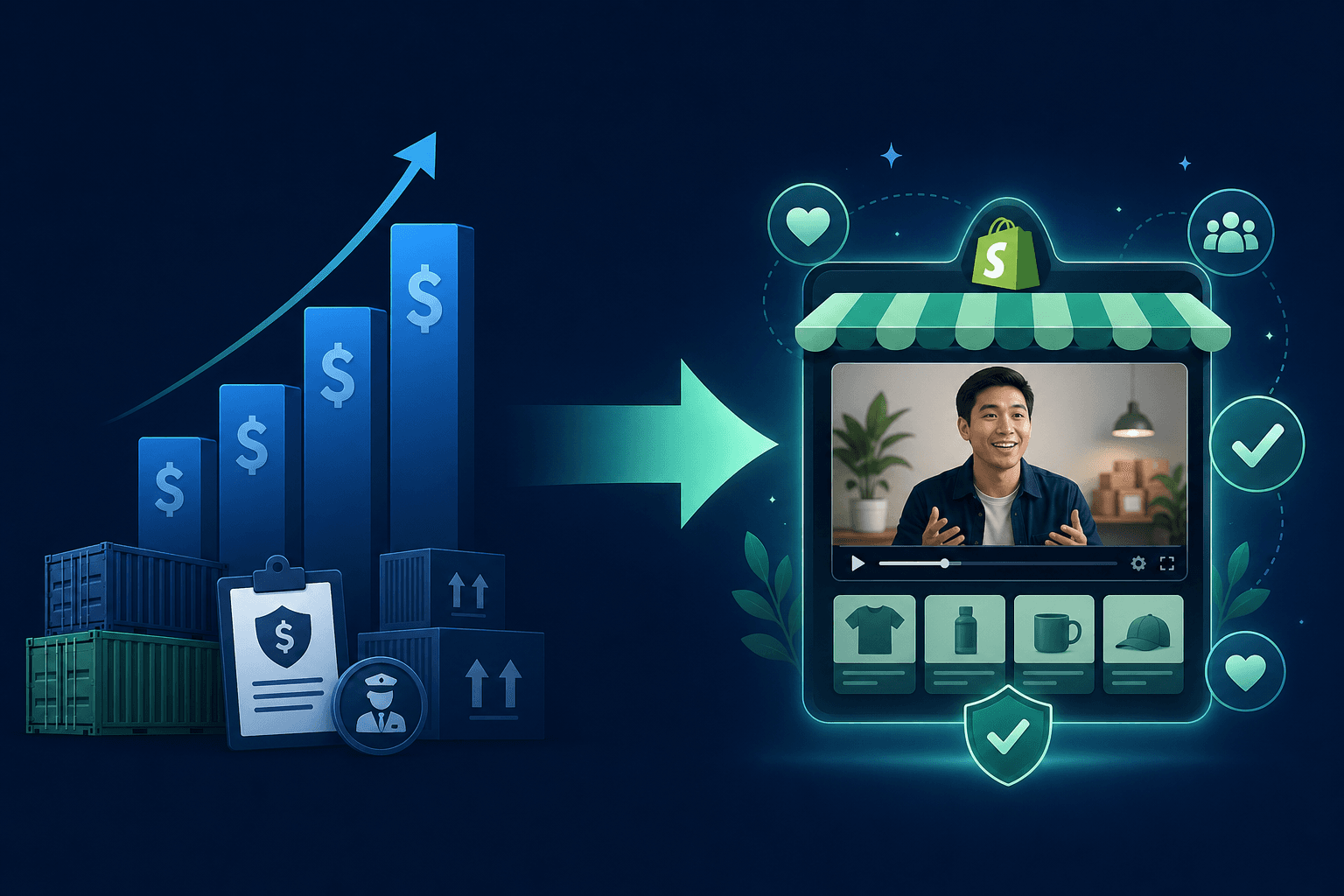
Tariffs Are Reshaping E-Commerce: The Brands That Tell Their Story Will Win
The de minimis exemption is gone. Tariffs are spiking landed costs. The Shopify brands that survive are the ones justifying their price with story.
If you import anything to sell on Shopify, 2026 has already hit your margins. The de minimis exemption, the $800 threshold that let low-value shipments enter the U.S. duty-free, is gone. Tariffs on Chinese goods have stacked to 15-30% of product cost. And the EU is following suit, eliminating its €150 duty exemption starting July 1, 2026.
For merchants who built their business on affordable imported goods, the math has changed overnight. But this isn't just a logistics problem. It's a storytelling problem. When your prices go up, customers demand to know why. The brands that can answer that question visually, authentically, and on their own product pages will keep their customers. The ones that can't will lose to whoever is cheapest.
The De Minimis Era Is Over
For more than two decades, Section 321 of the Tariff Act gave cross-border e-commerce a structural advantage. Any shipment valued under $800 entered the United States duty-free with no tariffs, no formal customs entry, and no broker paperwork. That exemption processed over 1.4 billion packages in 2024 alone.
That era ended in stages:
- May 2, 2025: De minimis eliminated for goods from China and Hong Kong. All non-postal shipments under $800 now require full customs entry and are subject to all applicable duties, including reciprocal tariffs.
- August 29, 2025: De minimis removed for all countries. Every shipment entering the U.S. now faces duties regardless of value.
- July 1, 2026: The EU begins phasing out its €150 duty exemption, applying a temporary €3 customs duty per tariff heading on low-value imports, with an additional handling fee by November 2026.
The practical impact is brutal. A beauty brand importing 300 units from China at a landed value of $2,400 now pays roughly $628 more per shipment in duties and broker fees than it did in 2024. Multiply that by monthly reorders, and the annual hit is five figures on a product that used to clear customs for free. A Yale study put the total economy-wide cost at $13 billion.
Rising Costs Mean Rising Scrutiny
Here's what the tariff conversation misses: the cost increase isn't the hardest part. The hardest part is passing it through to customers who are already price-sensitive.
According to FlavorCloud's 2025 data, 48% of shoppers abandon their cart when unexpected costs appear at checkout, and roughly 10% of DDU (Delivered Duty Unpaid) parcels are refused or returned because of surprise customs charges. Those numbers are climbing as de minimis thresholds fall globally.
The merchants feeling this most acutely are all over Shopify's community forums and Reddit: a Canadian merchant who got charged $7,500 in duties that should have been $0 due to CUSMA eligibility. An Australian store owner trying to figure out how to apply duties only to orders under $800. Merchants discovering Shopify's duty calculator was charging 100% duty on products that should have been at 15%.
These are real operational nightmares. But beneath the logistics chaos is a more fundamental problem: customers aren't just seeing higher prices. They're deciding whether those prices are worth it.
The Consumer Has Stopped Trusting the Default
Price increases don't happen in a vacuum. They happen in a market where consumer trust is at its lowest point in years, and where the brands that earn trust are rewarded disproportionately.
Emplifi's 2026 Digital Authenticity report, published April 15, surveyed more than 1,600 U.S. and UK consumers and found:
- 93% say authentic brand engagement builds trust
- 85% would pay more for brands they perceive as authentic
- 52% would stop buying from a brand after an inauthentic experience
- For items costing more than $500, 56% spend more than an hour researching, a 24 percentage point increase from 2023
Read that last stat again. When prices go up, research goes up. Customers are spending more time deciding whether to buy, reading more reviews, watching more videos, digging deeper into who makes the product and why. And if your product page doesn't answer those questions, someone else's will.
This is why founder-led brands are thriving. When a real person explains why a product costs what it costs, where the materials come from, what trade-offs were made, and why quality was prioritized over margin, it creates a trust signal that no corporate product description can replicate. The consumer doesn't need the price to be the lowest. They need to understand the value.
Your Product Page Needs to Answer "Why This Price?"
Most Shopify product pages are built for the pre-tariff world. They show the product. They list the specs. They display the price. And they assume the customer's only question is "do I want this?"
In 2026, the customer's question is more likely: "Why does this cost $45 when I can find something similar for $22?"
Your product page needs to answer that question, and video is the most effective medium to do it. Here's why:
- Text descriptions don't convey craft. "Ethically sourced" and "premium materials" are meaningless without proof. A 30-second video of your supplier's workshop, your quality testing process, or your founder holding the raw materials tells the story in a way that copy never can.
- Photos show the product. Video shows the value. A static image of a leather bag looks the same whether it costs $40 or $400. A video showing the tanning process, the hand-stitching, and the founder explaining the 50-year warranty makes the $400 version make sense.
- Customer videos prove the claim. When a real customer shows your product after 6 months of daily use, still holding up and still looking good, that's the strongest possible answer to "is it worth the price?"
This isn't theoretical. According to Emplifi's research, consumers now rank user-generated content (63%) nearly as high as search engine results (66%) as the most authentic content types. Brand-produced marketing ranks significantly lower. Your customers trust what other customers show them more than anything you tell them.
How to Use Video to Justify Your Value
You don't need a production budget. You need a camera, a story, and a place to tell it. Here's a practical framework:
1. Film Where It's Made
If tariffs are raising your prices because of import costs, show the customer what those imports actually look like. Film your supplier's facility. Show the raw materials. Walk through the manufacturing process. If you're shifting production domestically to avoid tariffs, tell that story too. "We moved our production to North Carolina to keep quality consistent and avoid tariff pass-throughs" is a powerful narrative.
2. Record the Founder Explaining the Price
This is the single most effective video format for justifying pricing. A 60-second video of the founder or a key team member explaining: "Here's what goes into this product, here's what changed with tariffs, here's why we chose to maintain quality instead of cutting corners." It humanizes the brand and reframes the price as a deliberate choice, not an arbitrary number.
3. Show Quality Side-by-Side
If your product genuinely outperforms cheaper alternatives, prove it. Durability tests. Material comparisons. Unboxing your product next to the $22 version. This works especially well as UGC: encourage your customers to make these comparison videos and feature them on your product page.
4. Collect and Display Customer Longevity Stories
Ask your repeat customers to share video reviews after extended use. "I've had this bag for two years and it still looks new" is worth more than any marketing claim. A single authentic video testimonial on your product page converts skeptics more effectively than a dozen five-star text reviews.
5. Place Videos Where the Decision Happens
Pricing justification videos don't belong on Instagram where they'll disappear in 24 hours. They belong on your product page, where every single customer who's weighing whether to buy will see them. Use brand story formats on your About page, behind-the-scenes videos on product pages, and customer testimonials throughout the purchase flow.
Tools like ReelTok let you embed these videos directly on your Shopify store as Stories, Carousels, or Floating Reels, tagged to specific products so customers can watch, understand the value, and buy without friction.
Tariffs Are Temporary. Your Story Is Permanent.
The tariff landscape will keep shifting. The Supreme Court may rule on the legality of sweeping trade duties. Trade agreements may soften rates. New exemptions may emerge. But the brands that invested in telling their story, who their founders are, how their products are made, and why their quality justifies the price, will come out ahead regardless of what happens in trade policy.
Because the real competitive advantage was never the cheapest price. It was the brand that made customers feel confident they got their money's worth.
Your margins are under pressure. Your costs are climbing. The answer isn't to race to the bottom. It's to give your customers a reason to stay at the top. Tell that story. Put it on your product page. And let your brand speak for itself.
Ready to bring your brand story to your product pages? Try ReelTok free and add shoppable video to your Shopify store in five minutes, no code required.
Related articles
More from Market Trends

TikTok Shop's $23 Billion Year: What It Means for Your On-Site Video Strategy
TikTok Shop is on pace for $23.4B in US sales in 2026. Here's what that growth actually means for Shopify merchants who don't sell there.
Meta's Worst Week: What the Landmark Court Rulings Mean for E-Commerce Brands
Meta lost two landmark court cases in one week and faces an FTC appeal. Here's what Shopify store owners need to know about platform risk.