

Stop Choosing Between AI and UGC. Your Store Needs Both.
UGC drives 6.7x higher conversions. AI fills your content gaps in 60 seconds. Here's how to run both on your Shopify store.
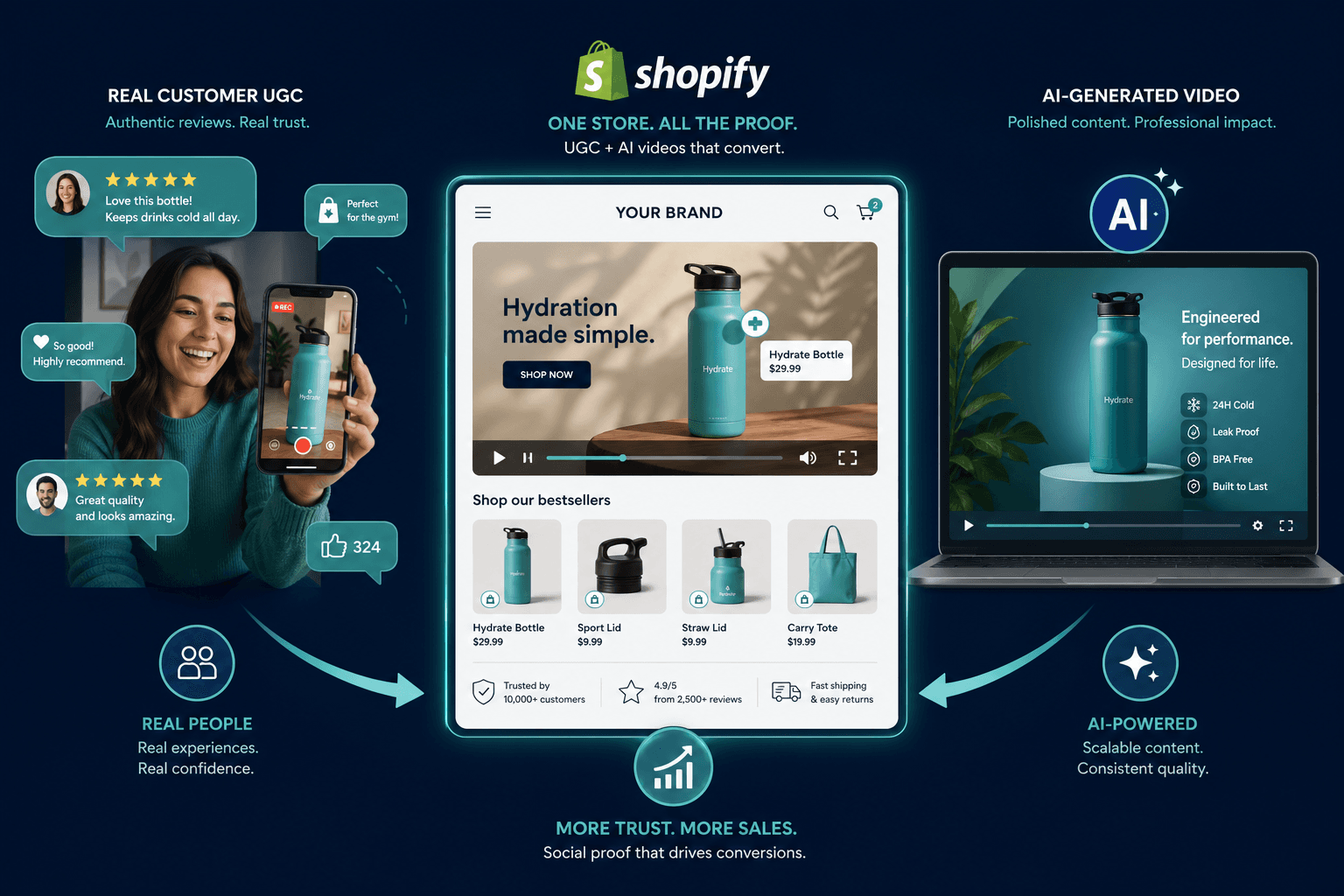
Most Shopify stores are only running half a social proof strategy. They have either polished brand content or authentic customer videos, but rarely both on the same product page. That gap is expensive. 79% of consumers say user-generated content influences their purchase decisions. Pages featuring UGC see 6.73x higher conversions than those without, according to Emplifi's Q1 2026 benchmarks. And 93% of consumers say authentic brand engagement builds trust, directly affecting whether they buy, return, and recommend.
The problem is that most Shopify stores are running an incomplete social proof strategy. Some have great customer UGC but only on TikTok and Instagram, where it evaporates in 48 hours and never touches someone actively shopping on their site. Others have polished brand content but nothing that answers the shopper's most important question: Did this work for someone like me?
The stores converting at the highest rates in 2026 are doing both. AI-generated brand videos fill every product page with professional content from day one. Real customer UGC builds the trust layer that brand content alone can never provide. Together, they cover the full spectrum of what a shopper needs to feel confident buying. Here's how to build that strategy.
Why Social Proof Has Two Jobs
Not all social proof does the same thing. When a shopper lands on your product page, they're running two parallel checks:
- The confidence check: "What is this product? What does it do? Does it look high-quality?" This is answered by professional brand content that clearly communicates features, materials, and use cases.
- The trust check: "Did this actually work for someone like me? Is this brand real?" This can only be answered by content from real people who actually bought and used the product.
Brand-produced content, no matter how polished, cannot pass the trust check on its own. A merchant explaining why their product is great will always carry less weight than a customer who has nothing to gain from saying so. Conversely, raw UGC alone often fails the confidence check: an enthusiastic but shaky customer video doesn't always communicate what a product is or why it's worth the price.
You need both. Most stores have one. The two-layer strategy closes the gap.
Layer 1: Real UGC and the Trust Signal No Brand Can Replicate
Emplifi's 2026 Digital Authenticity report found that consumers rank user-generated content (63%) as the second most trusted content type after search engine results (66%), well above brand-produced marketing. And 85% say they'd pay more for brands they perceive as authentic.
That trust premium comes from one thing: real customers have no incentive to lie. When someone films themselves using your product two months after purchase and says "still holding up, still love it," that's a message no brand video budget can replicate.
The Best UGC Types for Conversion
- Video testimonials: A customer on camera explaining why they bought, what problem it solved, and whether they'd buy again. The most persuasive format because it's the hardest to fake.
- Unboxing and first-impression videos: The excitement of receiving the product, including real packaging, real reactions, and real first impressions. Builds anticipation for new buyers.
- Before/after and in-use demonstrations: Showing the product working in a real context such as home, gym, kitchen, or office. Answers "will this work in my life?" far better than any staged shoot.
- Long-term use reviews: "I've had this for six months" videos are conversion gold, especially for higher-priced items where durability and value are the deciding factors.
Where UGC Works Hardest on Your Store
Customer videos that live only on TikTok or Instagram have a lifespan measured in hours. The same video embedded on your product page works for you every day, for every visitor who's weighing whether to buy. As we covered in how to turn TikTok and Instagram content into Shopify sales, repurposing your best social content onto your store is one of the highest-leverage moves available.
- Product pages: Video testimonials as full-screen Stories, placed right below the buy button where the decision happens
- Homepage: A scrollable Carousel of your top-performing customer videos as the first trust signal a new visitor sees
- Collection pages: Floating Reels that keep browsers engaged and reduce bounce while they consider options
Pages featuring UGC see 4.11x more site visits than those without, per Emplifi's Q1 2026 data. The traffic lift alone makes the placement worthwhile, before the conversion multiplier even kicks in.
Layer 2: AI-Generated Brand Content and Video for Every Product, Day One
Here's the reality for most Shopify stores: UGC takes time to accumulate. A new product launch has zero customer videos. A store with 200 SKUs might have strong UGC for its top 10 sellers and nothing for the rest. And waiting for organic UGC before putting video on a product page means leaving conversions on the table every day in the meantime.
This is where AI-generated brand content earns its place. It's not a substitute for authentic customer voices. It's a complement that solves a different problem: the production gap.
What AI Video Does Well
AI video generation has matured to the point where a merchant can go from product URL to publishable video in under a minute. For Shopify stores, the most useful formats are:
- Avatar UGC: An AI presenter pitches your product in a creator-style format with the look and feel of a real person review, delivered at production speed without influencer fees or scheduling. Best for product pages and social ads during a launch window before real UGC arrives.
- B-Roll with voiceover: Clean product visuals with a professional script and voiceover. Zero production overhead, consistent quality across your entire catalog. Works at scale: a store with 200 products can have a video for every single one.
- Avatar Demo: An AI presenter walks through your product in a custom scene, effectively a tutorial or sales pitch in video format. Ideal for products that require explanation around how to use, how to set up, or what to expect.
- Product Staging: A dynamic, animated showcase that puts your product front and center in a polished visual. Five seconds of attention capture on a homepage hero or collection banner.
The through-line: AI brand content answers the confidence check. It tells the shopper what the product is, what it does, and why it's worth the price, clearly and consistently.
The Production Gap Is Real
81% of e-commerce marketers say visual UGC outperforms professional or influencer content for customer trust, but most stores still have no video on the majority of their product pages. AI video generation closes that gap immediately so every product can have video on day one.
How the Two Layers Work Together
The two-layer strategy isn't about choosing between AI and UGC. It's about deploying each where it does its best work and letting them reinforce each other over time.
The Practical Playbook
At launch: Use AI to generate brand videos for every product in your catalog before a single customer has made a purchase. Product pages go live with video. The confidence check is covered from day one.
First 30-60 days: Run a post-purchase UGC collection flow. Send a follow-up email 10 days after delivery: "Show us [product name] in action. We'd love to feature you." Offer a discount code as an incentive. The first real customer videos start coming in.
As UGC accumulates: Add customer video testimonials to your product pages alongside the AI brand content on your highest-traffic listings. The trust layer stacks on top of the confidence layer. Now a shopper sees both what the product does and how a real customer experienced it, on the same page, without leaving to look for reviews.
Ongoing: Surface your best-performing customer and employee-generated content on your homepage and collection pages. Keep AI video covering the long tail, meaning newer products and lower-volume SKUs where UGC is still sparse.
This mirrors how the strongest stores approach owning their brand story: use every content tool available, but anchor it to your own store where you control the experience and it works for you around the clock.
Where to Place Each Content Type on Your Store
The right placement depends on what job each video is doing and where in the purchase journey the shopper is:
| Page | Best for AI Content | Best for Real UGC |
|---|---|---|
| Product page | B-Roll demo, Avatar Demo explaining features | Video testimonials as Stories, full-screen above the fold |
| Homepage | Product Staging on hero banner or featured section | Carousel of top-performing customer reviews |
| Collection page | Avatar UGC for new or lower-traffic products | Floating Reels from customers who own products in the collection |
| About / Brand page | Brand story b-roll with founder voiceover | Customer stories and long-form testimonials |
The goal is to ensure that no product page and no key landing page is a video dead zone. A shopper who encounters your store without any video proof has only text and static images standing between curiosity and a closed tab.
The Result: A Store That Converts at Both Ends
Stores running the two-layer strategy close the loop on the full shopper journey. AI brand content answers "what is this and does it look credible?" the moment someone lands. Real UGC answers "did it actually work?" when the shopper is one click from buying. 82% of consumers say they're more likely to buy from brands that use UGC in their marketing, and that number climbs when the UGC lives on the store itself, in context, at the point of decision.
You don't need to choose between fast and authentic. Fast gets you video on every page. Authentic gets you trust. Your store needs both.
ReelTok is built for this exact strategy. Import your best customer videos from TikTok, Instagram, or directly from your customers and publish AI Studio-generated product demos, b-roll, avatar presentations, and staging videos, all as shoppable Stories, Carousels, and Floating Reels anywhere on your Shopify store. Try ReelTok free: no code, five minutes to set up, first AI Studio video on us.
Related articles
More from UGC & Social Proof
Stop Building on Borrowed Ground: Why Shopify Stores Need to Own Their Brand Story in 2026
Facebook organic reach is under 2%. Meta is demoting non-original content. Here's why your Shopify store should tell your brand story.
Employee-Generated Content: The E-Commerce Video Trend Outperforming Influencers
EGC videos hit a 20% conversion rate — 9x the industry average. Here's why employees are your store's best content weapon.
The Ultimate Guide to Partnering with Influencers through Shopify Collabs
Learn how to partner with influencers through Shopify Collabs to boost your brand and explore career opportunities at Shopify.